
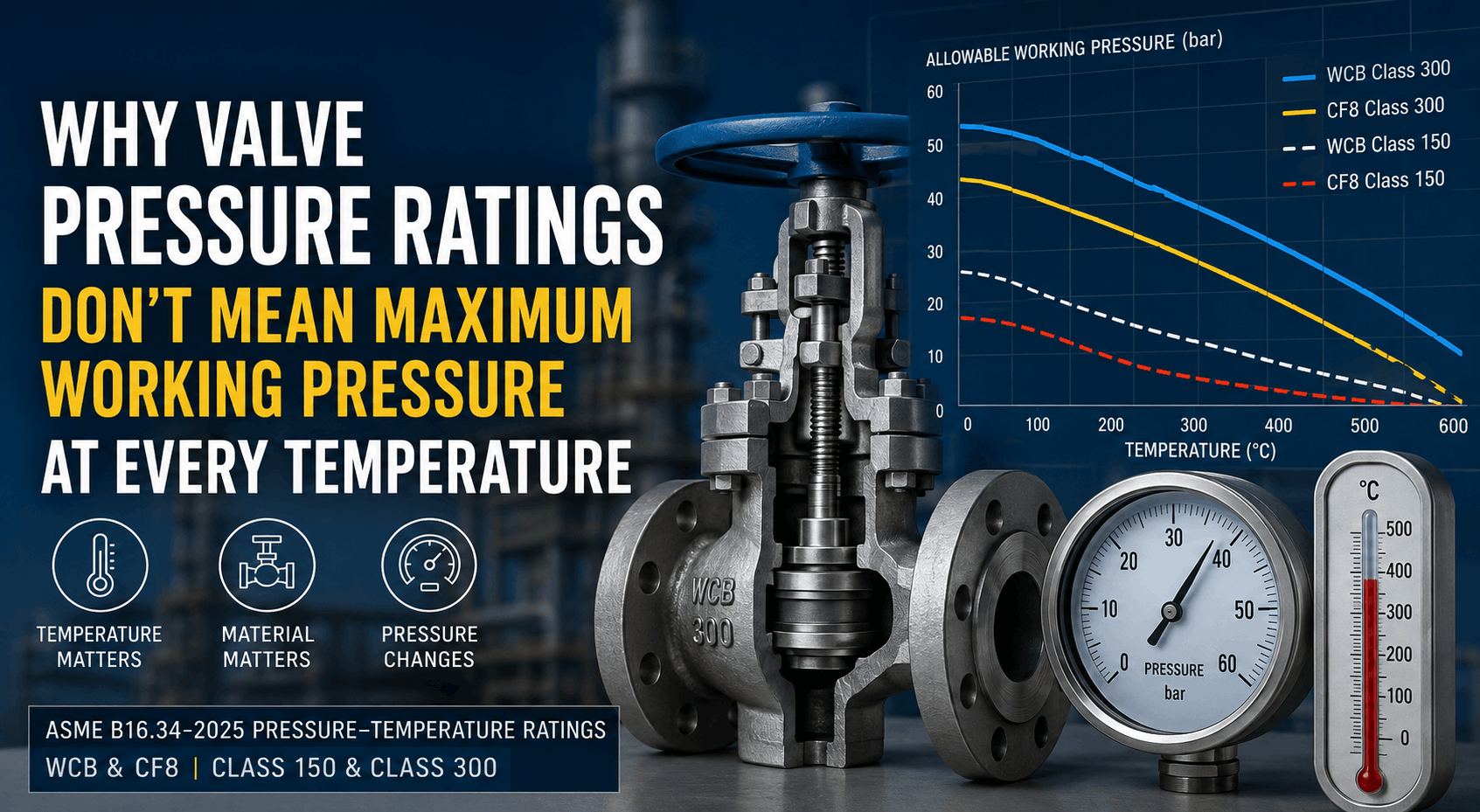
Why Valve Pressure Ratings Don\'t Mean Maximum Working Pressure at Every Temperature
When specifying an industrial valve, pressure class is one of the first parameters engineers consider. A valve may be specified as ASME Class 150 or Class 300, with pressure-containing components manufactured from materials such as ASTM A216 Gr. WCB or ASTM A351 Gr. CF8.
However, the pressure class does not represent one fixed allowable working pressure across all temperatures.
Under ASME B16.34, valve pressure ratings are defined as pressure-temperature ratings. The allowable pressure depends on the pressure class, material group, and operating temperature.
This means that a Class 300 valve operating at ambient temperature can have a substantially different allowable pressure when operating at 300°C or 400°C.
WCB and CF8 Pressure-Temperature Ratings
The following table shows selected standard-class pressure-temperature ratings for WCB and CF8 valves commonly used in industrial applications.
| Temprature | WCB Class 150 | WCB Class 300 | CF8 Class 150 | CF8 Class 300 |
| <38°C | 19.6 bar | 51.1 bar | 19.0 bar | 49.6 bar |
| 50°C | 19.2 bar | 50.1 bar | 18.3 bar | 47.8 bar |
| 100°C | 17.7 bar | 46.6 bar | 15.7 bar | 40.9 bar |
| 150°C | 15.8 bar | 45.1 bar | 14.2 bar | 37 bar |
| 200°C | 13.8 bar | 43.8 bar | 13.2 bar | 34.5 bar |
| 250°C | 12.1 bar | 41.9 bar | 12.1 bar | 32.5 bar |
| 300°C | 10.2 bar | 39.8 bar | 10.2 bar | 30.9 bar |
| 350°C | 8.4 bar | 37.6 bar | 8.4 bar | 29.6 bar |
| 375°C | 7.4 bar | 36.4 bar | 7.4 bar | 29.0 bar |
| 400°C | 6.5 bar | 34.7 bar | 6.5 bar | 28.4 bar |
| 425°C | 5.5 bar | 28.8 bar | 5.5 bar | 28.0 bar |
| 450°C | 4.6 bar | 23.0 bar | 4.6 bar | 27.4 bar |
| 475°C | 3.7 bar | 17.4 bar | 3.7 bar | 26.9 bar |
| 500°C | 2.8 bar | 11.8 bar | 2.8 bar | 26.5 bar |
| 538°C | 1.4 bar | 5.9 bar | 1.4 bar | 24.4 bar |
| 550°C | - | - | 1.4 bar | 23.6 bar |
| 575°C | - | - | 1.4 bar | 20.8 bar |
| 600°C | - | - | 1.4 bar | 16.9 bar |
| 650°C | - | - | 1.4 bar | 11.3 bar |
| 700°C | - | - | 1.4 bar | 8.0 bar |
| 750°C | - | - | 1.4 bar | 5.8 bar |
| 800°C | - | - | 1.2 bar | 3.5 bar |
| 816°C | - | - | 1.0 bar | 2.8 bar |
Reference values based on the standard-class pressure-temperature ratings of ASME B16.34-2025. The applicable standard edition, material requirements, valve construction and service conditions should always be verified for the specific application.
What the Numbers Actually Tell Us?
Consider a WCB Class 150 valve.
At temperatures up to 38°C, its standard rating is approximately 19.6 bar. At 200°C, the rating falls to 13.8 bar, and at 350°C it is only 8.4 bar.
The valve remains Class 150 throughout. What has changed is the allowable pressure at the operating temperature.
The same effect can be seen with Class 300. A WCB Class 300 valve is rated at approximately 51.0 bar at temperatures up to 38°C, but its rating falls to 37.6 bar at 350°C and 34.6 bar at 400°C.
The reduction also becomes more pronounced at higher temperatures. At 450°C, the WCB Class 300 rating falls to approximately 23.0 bar, and at 500°C it is only 11.5 bar.
Material Makes a Difference
Pressure class alone does not determine the allowable pressure. The material group also matters.
For example, compare WCB and CF8 Class 300 valves
| Temprature | WCB Class 300 | CF8 Class 300 |
| <38°C | 51.1 bar | 49.6 bar |
| 100 | 46.6 bar | 40.9 bar |
| 200 | 43.8 bar | 34.5 bar |
| 300 | 39.8 bar | 30.9 bar |
| 400 | 34.7 bar | 28.4 bar |
The two valves have the same pressure class, but their allowable pressures differ because the materials have different temperature-dependent properties and therefore different pressure-temperature ratings.
This is why the material specification is an integral part of valve selection, not simply a consideration for corrosion resistance or fluid compatibility.
Why Does Pressure Capability Decrease With Temperature?
The pressure-containing components of a valve must withstand the stresses produced by internal pressure.
As temperature increases, the mechanical properties and allowable stresses of materials change. At sufficiently high temperatures, long-term effects such as creep can also become important.
The pressure-temperature tables account for these material limitations by reducing the allowable pressure as temperature increases.
For example, a WCB Class 150 valve rated at 19.6 bar at ambient temperature has a rating of only 8.4 bar at 350°C.
Therefore, a process requiring 10 bar at 350°C could not simply use that Class 150 WCB valve based on its ambient-temperature rating.
At the same temperature, a WCB Class 300 valve has a rating of 37.6 bar, making it a substantially different pressure-temperature selection.
Pressure and Temperature Must Be Considered Together
The practical lesson is simple: valve selection should begin with the actual operating pressure and temperature, not pressure alone.
The basic selection process is:
Operating pressure → Operating temperature → Material → Pressure-temperature rating → Pressure class
For example, if a process requires a valve to operate at 15 bar and 350°C, the relevant question is not simply whether the valve is Class 150 or Class 300.
The question is whether the selected material and pressure class have an allowable pressure of at least 15 bar at 350°C.
High-Temperature Material Considerations
The numerical rating is not the only consideration at elevated temperature.
ASME B16.34 also includes material-specific notes and limitations. For example, Group 1.1 carbon-steel materials such as WCB have considerations regarding prolonged exposure at temperatures above approximately 427°C, where metallurgical changes can occur.
Consequently, high-temperature valve selection should consider the applicable material requirements and service conditions in addition to simply reading the pressure-temperature table.
Conclusion
A valve's pressure class should not be viewed as a single maximum working pressure.
The actual allowable pressure is determined by the combination of:
Pressure class + Material + Operating temperature
For WCB and CF8 valves, the ASME B16.34 pressure-temperature ratings clearly show how significantly allowable pressure can change as temperature increases.
A valve suitable for a particular pressure at ambient temperature may not be suitable for the same pressure at elevated temperature.
So when selecting a valve, the important question is not simply:
"What pressure class is the valve?"
It is:
"What pressure is this valve rated for at the actual operating temperature?