
Why a Valve That Passes a High-Pressure Water Test Can Still Fail a Low-Pressure Air Test
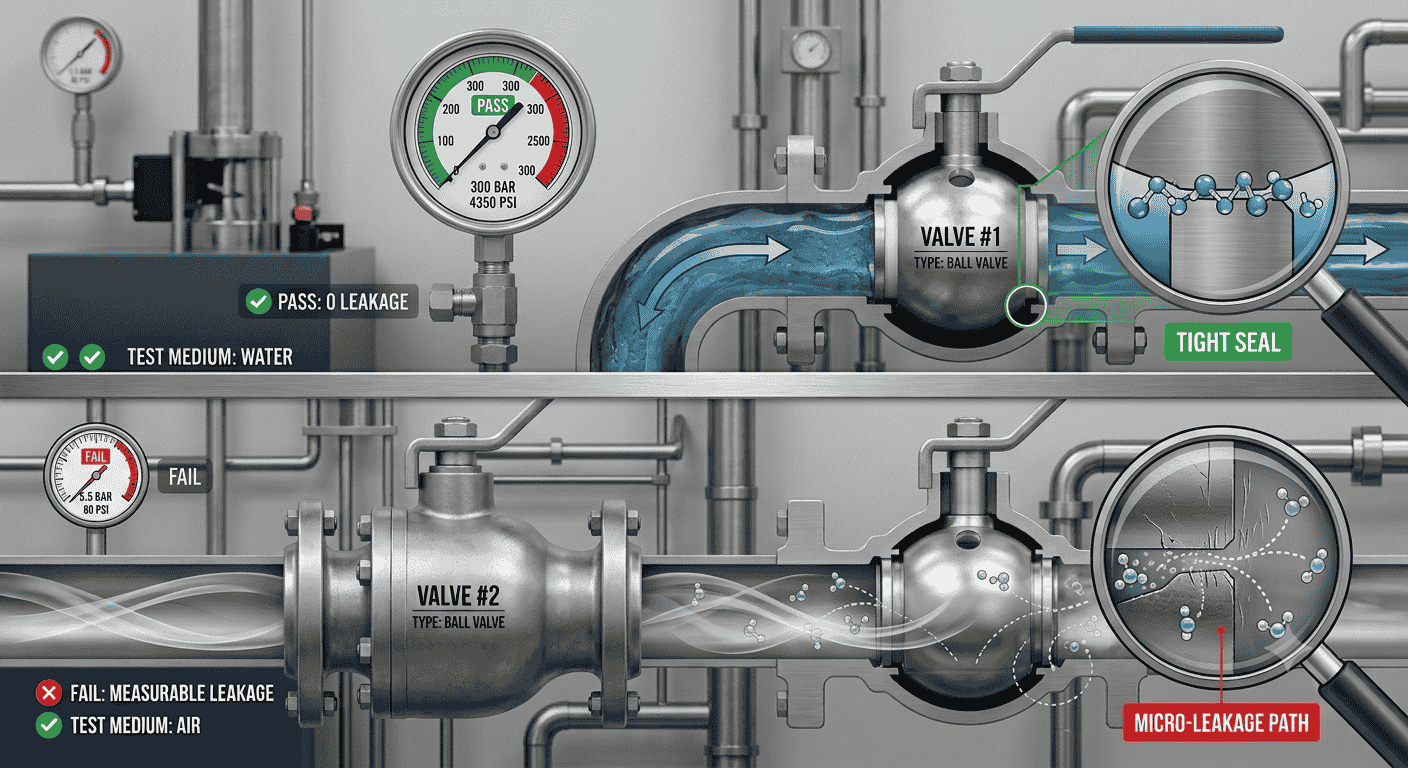
Imagine two valves fresh off the production line. During the high-pressure hydrostatic seat test, both perform perfectly—no visible leakage, no pressure drop, and everything appears to be in order.
However, when the same valves undergo the low-pressure air seat test, one of them suddenly fails.
How is this possible?
At first, it seems counterintuitive. If a valve can withstand high-pressure water without leaking, shouldn't it have no trouble sealing low-pressure air?
The answer lies in the fundamental differences between liquids and gases.
Understanding the Two Seat Tests
API 598 requires seat leakage testing under two different conditions for many valve types:
• High-pressure seat test using water.
• Low-pressure seat test using air or another suitable gas at approximately 5.5 bar (80 psi).
Although both tests evaluate seat tightness, they are designed to reveal different characteristics of the valve's sealing performance.
Water Is More Forgiving Than Air
Many people assume that because the hydrostatic test is performed at a much higher pressure, it is automatically the more demanding test.
From a structural standpoint, this is true. However, when evaluating seat leakage, the testing medium matters just as much as the pressure.
Water has relatively high viscosity and significant surface tension. These properties allow it to bridge microscopic imperfections between the seating surfaces. Tiny scratches, machining marks, or slight irregularities may not produce visible leakage during a water test.
Air behaves very differently.
As a compressible gas with much lower viscosity and virtually no surface tension, air can escape through leakage paths that water may never reveal. Even an extremely small gap can allow measurable air leakage while remaining completely leak-free during a hydrostatic test.
In other words, a valve may be watertight without being airtight.
What Does the Low-Pressure Air Test Detect?
The low-pressure air test is particularly effective at identifying small imperfections that could otherwise go unnoticed.
These include:
• Fine scratches on the seating surfaces.
• Minor machining defects.
• Slight misalignment between the disc and seat.
• Inadequate seating contact.
• Surface finish issues.
Because air is much more sensitive to these imperfections, the test provides an additional level of confidence in the valve's sealing performance.
Why Isn't the Water Test Enough?
If manufacturers relied only on the high-pressure water test, valves with extremely small leakage paths could still pass inspection.
While those leakage paths may not allow water to escape under test conditions, they can permit gas leakage in applications involving compressed air, steam, natural gas, or other gaseous media.
The low-pressure air test helps ensure that the seating surfaces are manufactured and assembled with the precision required for reliable shutoff.
Rather than duplicating the hydrostatic test, it complements it.
Different Tests for Different Purposes
The two tests evaluate different aspects of valve performance.
| Test | Test Medium | Primary Purpose |
| High Pressure Seat Test | Water | Verifies seat tightness under high-pressure hydrostatic conditions and confirms the valve can withstand its rated pressure without unacceptable leakage. |
| Low Pressure Seat Test | Air or suitable gas | Detects microscopic leakage paths that may not be visible during hydrostatic testing. |
Passing one test does not automatically guarantee passing the other because the behavior of liquids and gases is fundamentally different.
Why Isn't the Air Test Performed at Full Pressure?
If air is more effective at detecting small leakage paths, a natural question arises: why does API 598 specify a low-pressure air test of approximately 5.5 bar (80 psi) instead of testing with air at the valve's full pressure rating?
The primary reason is safety.
Unlike water, gases are highly compressible and store a significant amount of energy when pressurized. If a component, test connection, or fixture fails during a high-pressure gas test, the rapid release of stored energy can be hazardous.
Water behaves differently. Because it is nearly incompressible, it stores very little energy even at high pressure, making hydrostatic testing a much safer method for verifying pressure integrity and high-pressure seat performance.
The low-pressure air test is therefore not intended to replace the high-pressure water test. Instead, it serves as a sensitive leakage check that can reveal extremely small leakage paths without introducing the risks associated with high-pressure gas testing.
Experience has shown that a relatively low gas pressure of approximately 5.5 bar (80 psi) is sufficient to detect microscopic imperfections in the seating surfaces that may not be evident during hydrostatic testing.
By combining high-pressure water testing with low-pressure air testing, API 598 provides a practical balance between safety, leakage sensitivity, and verification of valve performance.
Why API 598 Requires Both?
API 598 has been developed around decades of industrial experience. The combination of a high-pressure hydrostatic seat test and a low-pressure air seat test provides a more comprehensive assessment of valve sealing performance than either test alone.
One verifies performance under high-pressure liquid conditions.
The other verifies the integrity and precision of the sealing surfaces using a medium that is far more sensitive to tiny leakage paths.
Together, they help ensure that a valve is suitable for a wider range of operating conditions and service applications.
Final Thoughts
A valve that passes a high-pressure water test but fails a low-pressure air test is not necessarily a contradiction—it is a demonstration of why both tests exist.
Water and air interact with sealing surfaces in fundamentally different ways. By testing with both, API 598 ensures that valves are evaluated not only for their ability to withstand pressure, but also for the quality and integrity of their sealing surfaces.
Understanding why both tests are required also highlights the importance of following a comprehensive inspection process rather than relying on a single test. Consistent with this approach, every EXCEED® valve undergoes both the high-pressure hydrostatic seat test and the low-pressure pneumatic seat test in accordance with the applicable testing requirements before dispatch, helping ensure reliable sealing performance.