
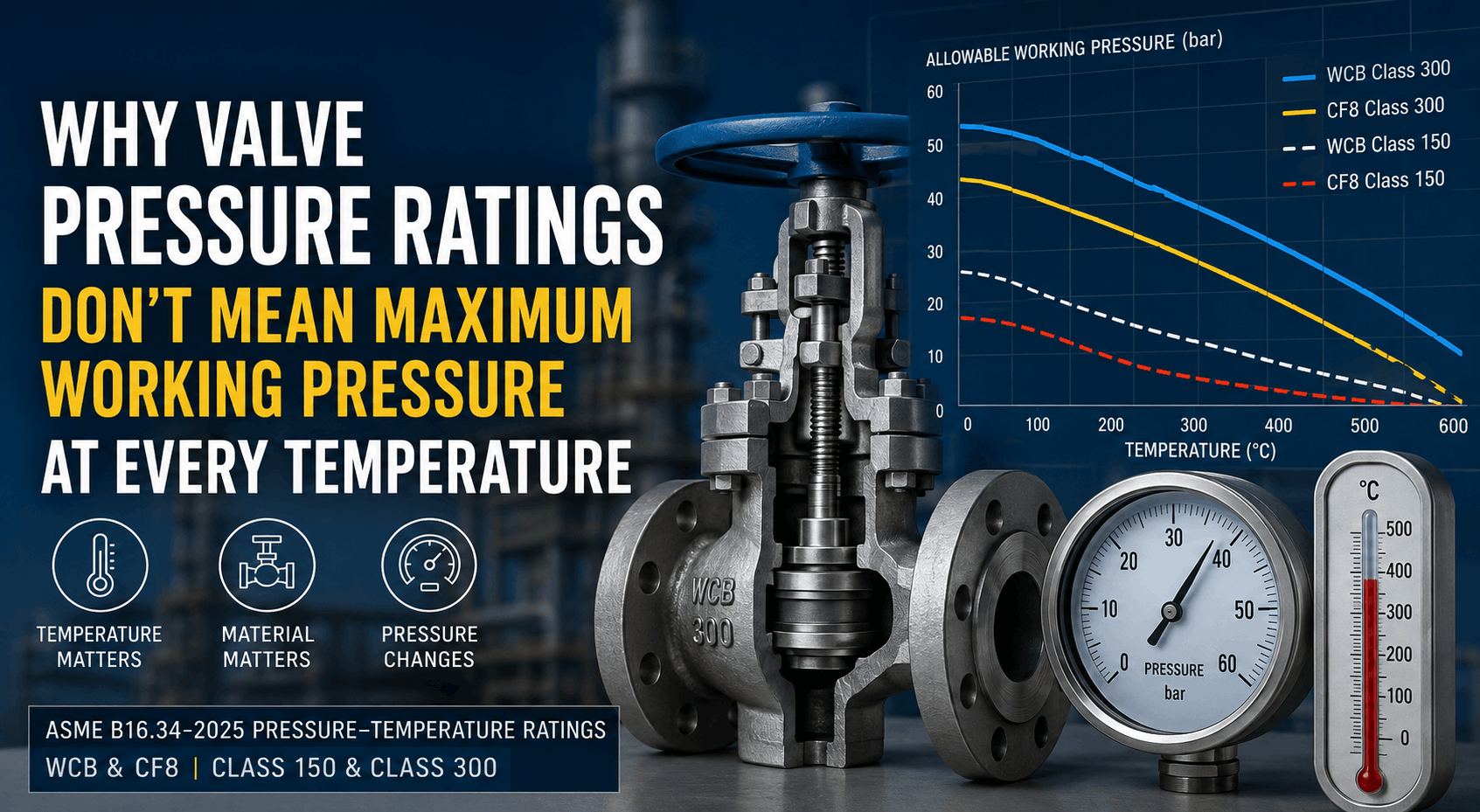
Why is a Valve Pressure Class Not a Fixed Pressure?
When specifying an industrial valve, pressure class is one of the first parameters engineers consider. Valves are commonly specified as ASME Class 150, Class 300, Class 600, and so on.
But does a Class 300 valve have one fixed allowable pressure?
No.
A valve's pressure class does not represent one fixed working pressure at every temperature or for every material. Under ASME B16.34, valve pressure ratings are pressure-temperature ratings. The allowable pressure depends on three key factors:
Pressure Class + Material + Operating Temperature
This means that two Class 300 valves made from different materials can have different allowable pressures. Likewise, the same Class 300 valve can have a different allowable pressure at 400°C than it has at ambient temperature.
Why Do Temperature and Material Affect Pressure Rating?
A valve's pressure-containing components, such as the body and bonnet, must withstand the stresses produced by internal pressure.
As temperature increases, the atoms within a metal gain thermal energy and vibrate more strongly. These increased vibrations make it easier for the material to deform when subjected to an external load. As a result, the material's ability to withstand stress generally decreases as temperature rises.
However, not all materials respond to temperature in the same way.
The chemical composition, alloying elements, microstructure and other metallurgical properties of a material determine how well it retains its mechanical strength at elevated temperatures. This is why materials such as ASTM A216 Gr. WCB and ASTM A351 Gr. CF8 do not have identical pressure-temperature ratings, even when used in valves of the same pressure class.
At sufficiently high temperatures, long-term effects such as creep can also become important.
Therefore, pressure rating cannot be determined from the pressure class alone. The material and operating temperature must also be considered.
How Does This Affect the Actual Pressure Rating?
The pressure-temperature ratings in ASME B16.34 demonstrate this relationship clearly.
The following table shows selected standard-class pressure-temperature ratings for WCB and CF8 valves:
| Temperature | WCB Class 150 | WCB Class 300 | CF8 Class 150 | CF8 Class 300 |
| <38°C | 19.6 bar | 51.1 bar | 19.0 bar | 49.6 bar |
| 100°C | 17.7 bar | 46.6 bar | 15.7 bar | 40.9 bar |
| 200°C | 13.8 bar | 43.8 bar | 13.2 bar | 34.5 bar |
| 300°C | 10.2 bar | 39.8 bar | 10.2 bar | 30.9 bar |
| 400°C | 6.5 bar | 34.7 bar | 6.5 bar | 28.4 bar |
| 500°C | 2.8 bar | 11.8 bar | 2.8 bar | 26.5 bar |
| 600°C | - | - | 1.4 bar | 16.9 bar |
| 700°C | - | - | 1.4 bar | 8.0 bar |
| 816°C | - | - | 1.0 bar | 2.8 bar |
Reference values based on the standard-class pressure-temperature ratings of ASME B16.34-2025. The applicable standard edition, material requirements, valve construction and service conditions should always be verified for the specific application.
The table shows two important things.
First, temperature changes the allowable pressure even when the material and pressure class remain the same.
For example, a WCB Class 300 valve has a rating of approximately 51.1 bar at 38°C, but this decreases to approximately 34.7 bar at 400°C.
Second, material changes the allowable pressure even when the pressure class and temperature remain the same.
At 400°C, for example:
• WCB Class 300 → 34.7 bar
• CF8 Class 300 → 28.4 bar
Both are Class 300 valves, but their allowable pressures are different because their material groups have different pressure-temperature ratings.
This is why Class 300 does not mean one universal pressure.
What Does This Mean for Valve Selection?
Consider a process that requires a valve to operate at 15 bar and 350°C.
Looking only at the pressure class could lead to the wrong selection. The question is not simply:
“Do I need a Class 150 or Class 300 valve?”
The more important question is:
“What is the allowable pressure of the selected material and pressure class at 350°C?”
This is because material is part of the pressure rating, not simply a consideration for corrosion resistance or fluid compatibility. Different materials respond differently to elevated temperatures and therefore have different pressure-temperature ratings.
For example, a WCB Class 300 valve and a CF8 Class 300 valve are both Class 300, but their allowable pressures at elevated temperatures are not necessarily the same.
Likewise, a WCB Class 150 valve that appears suitable based on its ambient-temperature rating may no longer be suitable when the operating temperature increases significantly.
Therefore, the valve must be selected based on the combination of:
Operating Pressure + Operating Temperature + Material → Applicable Pressure-Temperature Rating → Pressure Class
The pressure-temperature rating of the metal pressure-containing components is not necessarily the limiting factor for every valve. In soft-seated valves, the seat material may reach its temperature limit well before the metal body or other pressure-containing components experience a significant loss of strength.
Materials such as PTFE, reinforced PTFE and other soft-seat materials have temperature limitations that must be considered separately from the pressure-temperature rating of the valve body. Therefore, a valve may have sufficient metal pressure-temperature capability for a particular pressure and temperature while its soft seat is not suitable for that service.
The pressure-temperature table should not be treated as the only consideration for high-temperature valve selection.
Material-specific limitations, applicable notes in the governing standard, service duration and actual process conditions should also be reviewed.
For example, carbon-steel materials such as WCB have considerations associated with prolonged exposure to elevated temperatures. At sufficiently high temperatures, metallurgical changes and creep can become important.
Therefore, for high-temperature service, the valve should be evaluated using the applicable pressure-temperature rating together with the material requirements and actual service conditions.
Conclusion
A valve's pressure class is not a single maximum working pressure.
The actual allowable pressure depends on the combination of:
Pressure Class + Material + Operating Temperature
Changing the temperature can change the allowable pressure. Changing the material can also change the allowable pressure—even when the pressure class remains exactly the same.
So when selecting an industrial valve, the important question is not simply:
“What pressure class is the valve?”
It is:
“What pressure is this specific material and pressure class rated for at the actual operating temperature?”
Valve pressure ratings are not about pressure alone. They are about pressure at temperature, for a specific material.