
Understanding Water Hammer: How Valve Closing Affects Pipeline Pressure
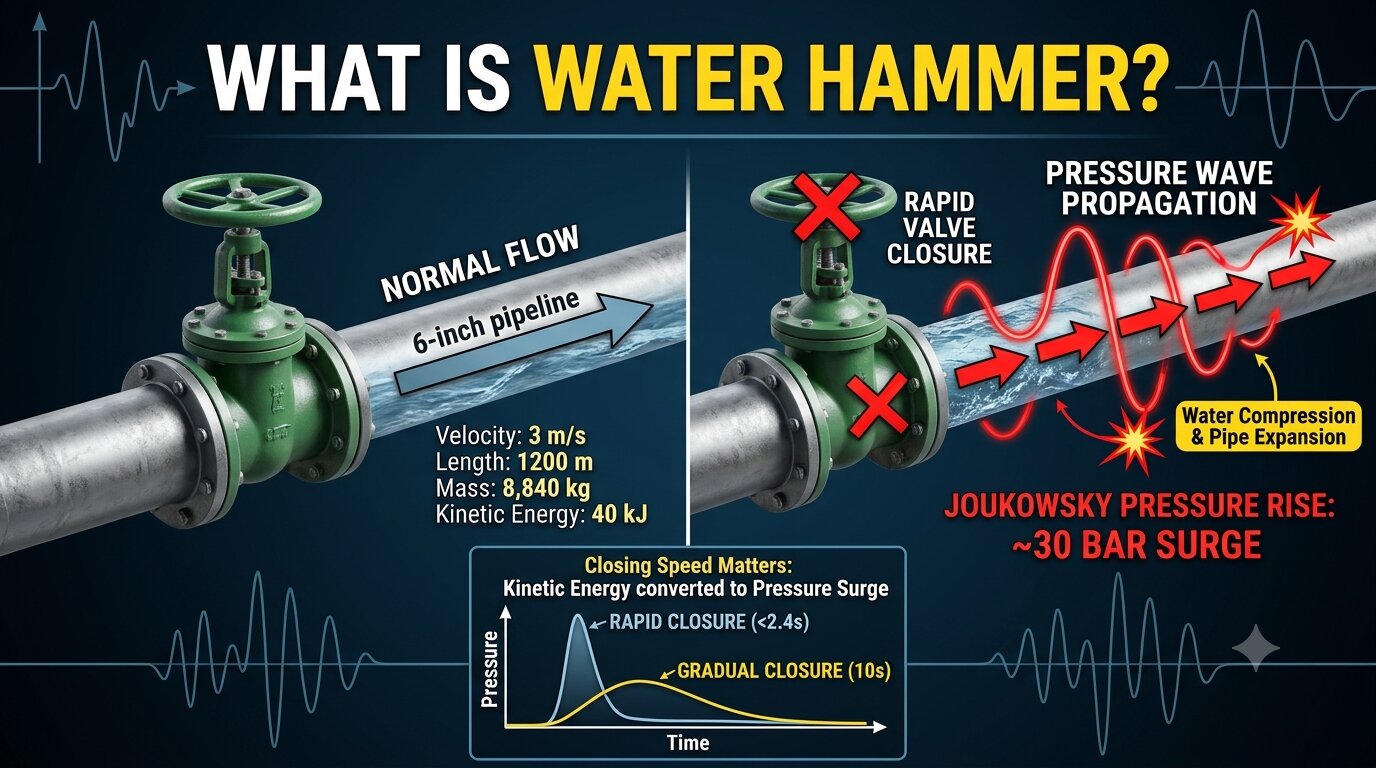
Consider water flowing through a 6-inch pipeline at a velocity of 3 m/s and a pipeline length of 500 metres.
The volume of water contained in this pipeline is approximately 8.84 m³, giving a water mass of about 8,840 kg. As this water flows through the pipeline, it carries kinetic energy associated with its motion.
The kinetic energy can be calculated using:
E = ½ m v²
Where
(m) is the mass of water
(v) is its velocity.
Substituting the values:
E = ½ × 8840 × 3² = 39.8 kJ
The moving water therefore carries approximately 40 kJ of kinetic energy. This is roughly equivalent to the kinetic energy of a 1,200 kg car travelling at 29 km/h.
Now imagine a valve closing and rapidly reducing the flow of this water. The moving water cannot simply stop everywhere in the pipeline at the same instant. Instead, the change in flow generates a pressure disturbance that travels through the pipeline.
The energy associated with the moving water, combined with the rapid change in its motion and the response of the pipeline, helps explain why a seemingly ordinary valve operation can produce a substantial pressure surge.
This phenomenon is known as water hammer. It can occur when a valve closes rapidly, a pump trips, or a check valve closes following flow reversal. Depending on the system, the resulting pressure surge can damage valves, pipework, joints, instruments and other equipment.
How Does a Pressure Wave Travel Through a Pipeline?
When a valve begins to close, it restricts the flow of water through the pipeline. The water immediately upstream of the valve experiences a change in pressure as the flow is disrupted. This change does not remain confined to the valve; it propagates through the pipeline as a pressure wave.
Although water is often treated as incompressible in ordinary flow calculations, it is not perfectly incompressible. When pressure increases, water undergoes a small compression, while the pipework also responds to the change in pressure. These effects allow the pressure disturbance to travel at a finite speed rather than being transmitted instantaneously throughout the entire pipeline.
As the wave travels, it may reach a reservoir, a closed valve, a change in pipe conditions or another boundary. Part of the disturbance may then be reflected back through the pipeline. These reflected waves can interact with the original disturbance and with subsequent changes in flow, causing pressure at a particular point to rise and fall over time.
The pressure surge is therefore not simply a matter of water hitting a closed valve. It is a pressure disturbance travelling through the system and interacting with the pipeline and its boundaries.
This also explains why two pipelines with similar flow velocities and valves can experience different pressure surges. Pipeline length, pressure-wave speed, system boundaries and the way the flow is reduced all influence the resulting pressure changes.
Why Closing Speed Matters: Critical Time and Pressure Surge Equations
The speed at which a valve reduces flow is one of the key factors determining the severity of water hammer. To understand why, it is useful to compare the time taken for the flow to change with the time taken for a pressure wave to travel through the pipeline and return.
For a pipeline with a relevant length (L) and a pressure-wave speed (a), the critical closure time is commonly estimated as the time required for a pressure wave to travel to a reflecting boundary and return:
T꜀ = 2L/a
Where:
(T꜀ ) is the critical time.
(L) is the relevant pipeline length.
(a) is the pressure-wave speed.
If the effective change in water velocity occurs in less than this time, the closure is considered rapid. The pressure rise can approach the value predicted by the Joukowsky equation.
If the velocity changes over a longer period, pressure waves have more time to travel and reflect while the flow is being reduced. Under suitable conditions, the resulting pressure rise can be estimated using the Michaud equation.
These two equations describe different cases of water hammer.
The Joukowsky equation estimates the pressure change associated with a rapid change in liquid velocity:
ΔP = ρ a ΔV
Where:
(ΔP) is the pressure change.
(ρ) is the liquid density.
(a) is the pressure-wave speed.
(ΔV) is the change in flow velocity.
The Michaud equation estimates the pressure change associated with a more gradual velocity change:
ΔP = 2ρLΔV / T
Where:
(ΔP) is the pressure change.
(L) is the relevant pipeline length.
(ΔV) is the change in flow velocity.
(T) is the effective time over which the velocity changes.
The distinction is important. When the valve closes in less than the critical time, the closure is considered almost instantaneous from the pipeline’s perspective, even if the valve takes a few seconds to close physically. In this case, the Joukowsky equation is used to estimate the pressure rise. When the velocity decreases over a period longer than the critical time, the Michaud equation can be used to estimate the pressure rise, accounting for both the pipeline length and the time taken for the velocity to change.
The critical time provides a useful guide for understanding whether a change in flow is rapid or gradual. It is not a universal safe-closing limit, because the actual pressure response also depends on the pipeline layout, system boundaries and how the valve reduces the flow.
Applying the Equations: A Numerical Example
Consider a pipeline with the following conditions:
- Pipeline length: 1,200 m
- Water density: 1,000 kg/m³
- Pressure-wave speed: 1,000 m/s
- Initial water velocity: 3 m/s
- Final water velocity: 0 m/s
The velocity change is therefore 3 m/s.
Calculating the critical time
Using the critical-time equation:
T꜀ = 2L/a
T꜀ = (2 × 1,200) / 1,000
T꜀ = 2.4 s
The critical time is 2.4 seconds. This gives us a reference for comparing the time taken for the water velocity to change.
Estimating the pressure rise for rapid closure
ΔP = ρ a ΔV
Substituting the values:
ΔP = 1,000 × 1,000 × 3
ΔP = 3,000,000 Pa
Since 1 bar equals 100,000 Pa:
ΔP = 30 bar
The estimated pressure change is approximately 30 bar. This illustrates how a rapid change in water velocity can produce a substantial pressure rise, even when the original flow velocity is only 3 m/s.
The calculated value is the pressure increase, not the final pipeline pressure. For example, if the initial pressure were 10 bar gauge, adding 30 bar would give 40 bar gauge at the point experiencing that pressure increase, assuming the conditions support this simple calculation.
Estimating the pressure rise for gradual closure
Now assume that the water velocity decreases approximately linearly over a period longer than the critical time.
If the effective velocity-change time is 5 seconds, the Michaud equation gives:
ΔP = 2ρLΔV / T
Substituting the values:
ΔP = (2 × 1,000 × 1,200 × 3) / 5
ΔP = 14.4 bar
If the effective velocity-change time is increased to 10 seconds:
ΔP = (2 × 1,000 × 1,200 × 3) / 10
ΔP = 7.2 bar
The comparison illustrates how extending the time over which the water velocity changes can reduce the estimated pressure rise. In this example, increasing the velocity-change time from 5 to 10 seconds halves the calculated pressure change.
Valve Closing Time vs. Actual Flow-Change Time
When discussing water hammer, it is important to distinguish between the time a valve takes to close mechanically and the time it takes for the water velocity to decrease.
A valve's closing time is usually measured from the fully open position to the fully closed position. However, the flow does not necessarily decrease at a constant rate throughout this movement.
For example, a valve may take 20 seconds to complete its closing stroke, but most of the flow reduction may occur during the final few seconds. In that case, the effective time over which the water velocity changes is much shorter than the valve's total closing time.
This happens because the relationship between valve opening and flow is not always linear. The change in flow depends on the valve's design, the shape of its opening and the pressure conditions across it.
Therefore, a longer mechanical closing time does not automatically mean a smaller pressure surge. What matters is how quickly the valve reduces the flow, particularly during the final part of its closing movement.
This is an important consideration when selecting and operating valves in systems where water hammer is a concern.
Why Check Valves Require Special Attention
Check valves deserve particular attention because they operate automatically in response to changes in flow direction. Unlike an actuated valve, their closing behaviour is closely linked to how quickly the water slows down and whether it begins to reverse direction.
Consider a pump supplying water through a pipeline. If the pump suddenly stops, the forward flow begins to decelerate. If the water starts flowing backwards before the check valve closes, the reverse flow can push the valve disc back against its seat.
This is known as check valve slam. The sudden stopping of reverse flow can produce a pressure surge in the pipeline.
The severity depends on how quickly the forward flow decelerates, how much reverse velocity develops before closure, and how the valve's moving parts respond.
Different check valve designs behave differently in these conditions. A conventional swing check valve, for example, may allow its disc to travel further before closing, while some spring-assisted or axial-flow designs are intended to close more quickly as forward flow decreases.
However, a faster-closing valve is not automatically the right choice for every application. The suitable design depends on the pump, pipeline layout, flow conditions and the likelihood of flow reversal.
For pump discharge lines, the check valve should therefore be selected with both normal flow performance and closing behaviour in mind.
The principles of pressure waves also apply to gas pipelines, but gases behave differently from liquids because they are much more compressible.
When gas flow changes, both its pressure and density can change significantly. This makes the relationship between flow velocity and pressure more complex than in the water examples discussed above.
The Joukowsky equation can be applied to gas under appropriate assumptions using suitable gas properties, but it should not be used blindly with the same values or assumptions used for water. The Michaud equation presented here is intended for liquid-flow applications and should not be directly used to predict pressure surges in gas pipelines.
Gas pipeline pressure changes must be assessed using methods suited to compressible flow and the operating conditions of the system.
Conclusion
Water hammer is a reminder that a valve's behaviour matters not only during normal operation, but also when the flow changes suddenly.
The Joukowsky equation shows how a rapid change in water velocity can produce a substantial pressure rise. The Michaud equation illustrates how extending the time over which the velocity changes can reduce the estimated surge.
For valve selection, the key is to look beyond the nominal closing time and understand how the valve actually affects flow. This is especially important for check valves, where the interaction between pump shutdown, flow reversal and valve closure can determine whether a pressure surge occurs.
Understanding these factors helps engineers choose and operate valves with greater awareness of the pressure changes that can occur throughout a pipeline.