
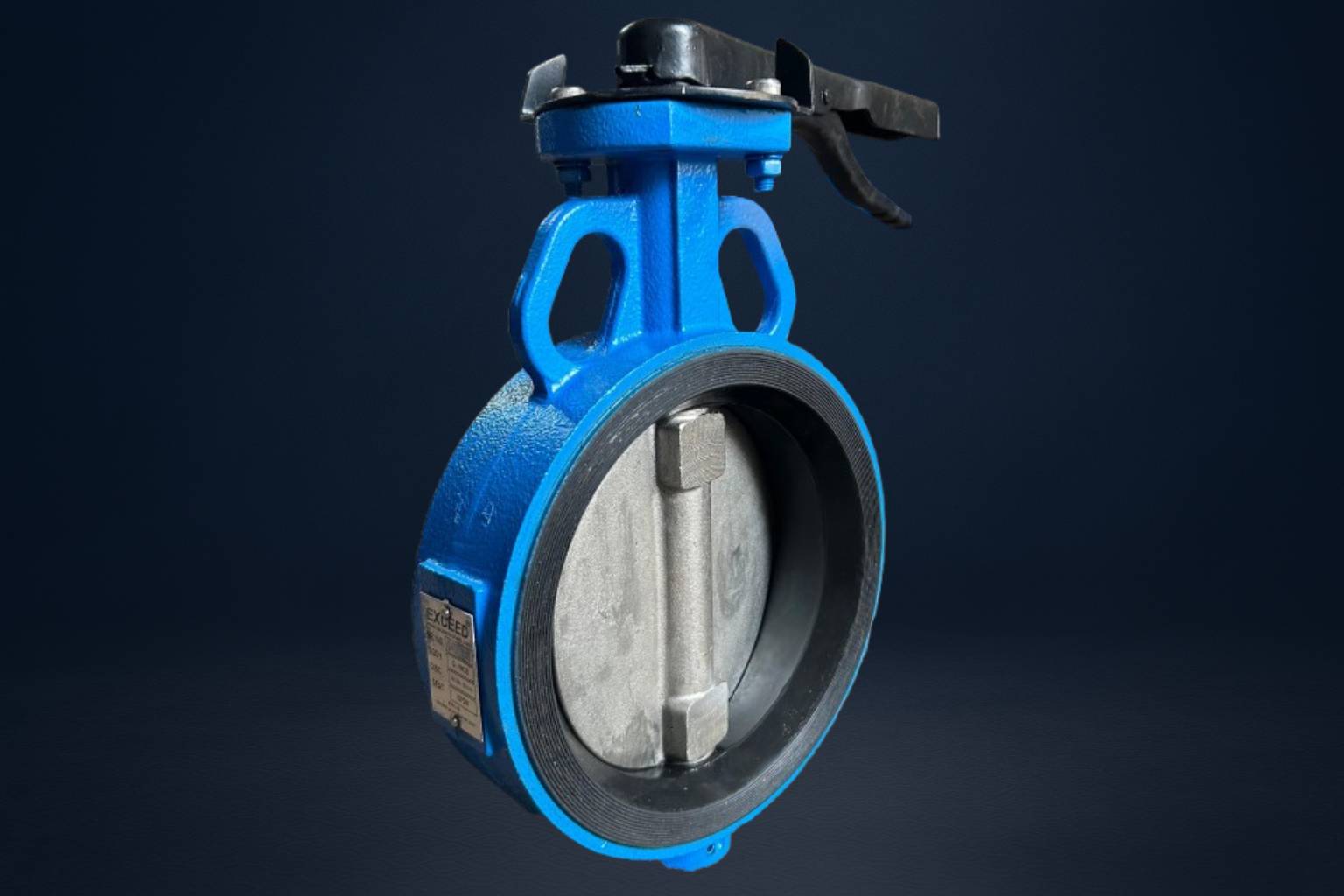
Butterfly Valves

Service Image

Butterfly Valves

Butterfly valves are quarter-turn valves designed for quick shut-off and flow regulation in pipelines. They use a rotating disc positioned in the center of the pipe; when turned parallel to the flow, the valve is fully open, and when rotated perpendicular, it is closed. This simple yet effective design makes butterfly valves lightweight, compact, and cost-efficient, especially compared to gate or ball valves of the same size.

Because of their low weight, smaller face-to-face dimensions, and fast operation, butterfly valves are ideal for large-diameter applications where other valve types may be bulky or expensive. They are widely used in water supply, HVAC, chemical, and process industries where space, cost, and reliable flow control are critical.

Exceed Butterfly Valves are engineered for smooth operation, tight shut-off, and durability. With robust body designs, precision-machined discs, and a variety of seat and material options, Exceed ensures dependable performance in diverse fluid service conditions.


Technical Details:

Valve Type: Centric Disc

Body Type: Short Wafer

End Connections: Wafer Type

Design Standards: BS EN 593

Face to Face: As per ASME B16.5 150 Class

Inspection & Testing: BS EN 12266-1


Engineering Options:

  • Available on request with gearbox & pneumatic actuator

The operation of a butterfly valve is based on the rotation of a disc inside the pipeline:

  1. Open Position
    When the handle or actuator rotates the disc to align parallel with the pipeline, fluid flows almost unobstructed. The streamlined disc design helps minimize pressure loss.

  2. Closed Position
    Rotating the disc 90° places it perpendicular to the flow, pressing it against a resilient seat to form a tight seal. This ensures effective shut-off with minimal leakage.

  3. Intermediate Position (Throttling)
    Butterfly valves are well-suited for flow control. By adjusting the angle of the disc, operators can regulate flow with good accuracy, making them versatile for both on/off and throttling service.

The quarter-turn mechanism makes butterfly valves easy to operate manually and well-suited for pneumatic or electric actuation, especially in large pipelines where remote or frequent operation is needed.

Butterfly valves are commonly used:

  • In large-diameter pipelines – where a compact, lightweight valve design reduces cost and space requirements.

  • In water distribution and treatment systems – for reliable isolation and flow control.

  • In HVAC systems – to regulate chilled water, hot water, or air flow.

  • In chemical and process lines – where quick shut-off and corrosion-resistant materials are required.

  • In automated systems – paired with actuators for efficient control of high-capacity lines.

  • Compact and Lightweight
    Butterfly valves require less space and are easier to install compared to gate or ball valves of similar size.
    Exceed designs lightweight yet robust bodies to simplify installation and reduce system costs.

  • Quick Operation
    A 90° turn fully opens or closes the valve, making it suitable for rapid response.
    Exceed provides smooth disc-stem mechanisms for easy manual use and reliable actuation.

  • Versatile Flow Control
    Suitable for both shut-off and throttling service, offering flexibility in system design.
    Exceed optimizes disc and seat geometry for precise regulation and tight shut-off.

  • Cost-Effective in Large Sizes
    Butterfly valves are more economical than ball or gate valves at larger diameters.
    Exceed leverages efficient manufacturing to provide durable valves at competitive pricing.

  • Automation Friendly
    Easily adapted for pneumatic or electric actuators in modern process systems.
    Exceed offers actuator-ready butterfly valves for seamless integration into automated operations.

No. Description Material
1 Body IS 210 Gr. FG 260 (Cast Iron)
2 Disc IS 210 Gr. FG 260 (Cast Iron)

S.G Iron


ASTM A351 Gr. CF8

3 Seat Nitrile

EPDM

4 Shaft AISI 410


Rating Working Pressure Temp. Hyd. Test Pressure (Body) Hyd. Test Pressure (Seat)
PN10 10 bar 120°C 15 bar 11 bar
PN16 16 bar 120°C 24 bar 17.6 bar